Natural Born Gamer: A Designer’s Embroidery Review
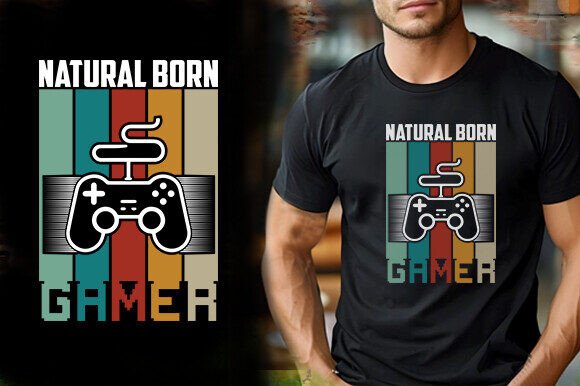
As a designer who spends half my life digitizing and the other half staring at stitched samples under a magnifying glass, I have learned to look past the initial flash of a graphic. When I first pulled up the NATURAL BORN GAMER TSHIRT DESIGN, my immediate reaction was not just about the aesthetic appeal, but about its structural integrity for real-world application. This is not merely a flat image; it is a potential machine embroidery design that needs to survive the tension of the hoop and the texture of fabric. For those of us running a craft business or managing an Etsy seller storefront, the difference between a digital file and a sellable finished product lies in these practical details.
First Impressions and Visual Personality
The mood of this piece is distinctly retro-futuristic, tapping into that nostalgic vein of video game culture that resonates across generations. Visually, the layout suggests a bold statement piece. For an embroidery project, this means we are likely dealing with significant coverage. The shapes appear robust, which is generally good news for stitch stability. However, the term "Graphics" in the product category hints at complex shading or gradients. In embroidery, we cannot simply print gradients; we must simulate them through thread blending or careful fill stitch placement. If the original artwork relies heavily on subtle color shifts, a digitizer must make strategic choices to maintain clarity without turning the design into a dense, cardboard-like patch on the garment.
I imagine this design sitting prominently on the chest of a hoodie or centered on the back of a jacket. It has the visual weight to command attention, making it ideal for custom apparel where the wearer wants to express their identity loudly. The "Natural Born Gamer" phrase implies a sense of innate talent and passion, which translates well into a gift context. Whether for a birthday or a holiday, this personalized gift concept works because it speaks directly to the recipient’s hobby.
Real-World Application and Substrate Choices
Let us move from theory to the hoop. I recently considered a similar gaming-themed motif for a client wanting a batch of sweatshirt embroidery pieces for a local e-sports team. The challenge with such bold T-Shirt Designs is always the fabric. A heavy cotton blend fleece handles high stitch density beautifully, providing a stable foundation for large fill stitch areas. However, if you attempt to place this same design on a lightweight performance tee, you risk puckering and distortion. The fabric simply cannot support the weight of the thread.
For a tote bag design, this graphic would shine. Canvas is sturdy, forgiving, and provides a neutral background that allows the thread colors to pop. I can envision this as a standout item in a small shop product lineup, appealing to parents carrying gear for their children or adults heading to a convention. Similarly, as an embroidered patch, this design could be incredibly versatile. Patches allow you to stitch the design on a stable twill backing before applying it to curved surfaces like caps or delicate items like baby clothes, bypassing many stabilization headaches.
When considering baby embroidery, caution is key. While the theme might appeal to millennial parents, the size and density must be reduced significantly. A full-scale version would be too stiff and uncomfortable for an infant’s skin. Scaling it down for a onesie requires checking that the text remains legible and the small details do not merge into a blob of thread.
Technical Considerations for Stitching Clarity
The success of any digital embroidery file hinges on how it handles transitions and edges. In this design, pay close attention to any small text or intricate controller details. Tiny lettering is the enemy of embroidery if not digitized with care. If the font is too thin, it may require a satin stitch column that is too narrow to hold together, leading to breaks or poor coverage. Conversely, if it is too wide, it becomes bulky. I recommend inspecting the simulation view closely. Look for excessive jump stitches or unnecessary trims that could slow down production time in a commercial embroidery setting.
Color contrast is another critical factor. On dark fabrics, light threads stand out, but they also show every gap in coverage. On light fabrics, dark threads provide definition but can cast shadows if the density is too high. Before committing to a full run, test the design on scrap fabric that matches your final product. Use the appropriate stabilizer; a cut-away stabilizer is often safer for stretchy knits used in t-shirts, while tear-away might suffice for woven tote bags. Always check the hoop size requirements. If the design exceeds standard 5x7 or 6x10 hoops, you will need a larger machine or a multi-hooping strategy, which increases the risk of alignment errors.
Commercial Viability and Brand Consistency
For design assets intended for resale, the licensing terms are paramount. The description mentions usage for Amazon, Etsy, and Teespring, which suggests a commercial license may be included, but you must verify this explicitly. Never assume. Selling finished items using someone else’s intellectual property without clear permission is a fast track to account suspension. Ensure that the applique design elements, if any, are clearly defined so you know whether you need to supply fabric layers or if it is purely stitched.
From a branding perspective, consistency matters. If your handmade product line focuses on high-quality, durable goods, this design must reflect that quality. Sloppy stitching or poor color choices will undermine customer trust. Use printable mockup tools to visualize how the design looks on different colored garments before you stitch a single thread. This helps in creating compelling listings for your digital product or physical inventory. A well-executed holiday embroidery gift featuring this design can become a bestseller if presented with professional photography and clear sizing information.
Final Verdict for Makers and Sellers
The NATURAL BORN GAMER TSHIRT DESIGN offers strong potential for makers who understand the technical demands of embroidery. It is not a plug-and-play solution for every fabric type, but with proper preparation, it can elevate a simple garment into a cherished item. Remember to test on scrap fabric, adjust density for delicate materials, and confirm all licensing rights. Whether you are creating a custom apparel line or a one-off personalized gift, the key is respecting the medium. Embroidery adds texture and dimension that prints cannot match, but it demands respect for its physical limitations. Treat this design as a collaborative partner in your creative process, and it will reward you with a professional, eye-catching result that stands out in the crowded marketplace of Graphics and T-Shirt Designs.